One developer instead of a team.
Interface, server, infrastructure, operations – I do all of it, and I do it myself. Projects work here that would otherwise mean coordinating three people, three calendars and three invoices.
Signs you need someone like me
If two of these describe your situation, a conversation is probably worth twenty minutes.
Nobody has the full picture.
A project has been stalled for months. Frontend waits on backend, backend waits on infrastructure, and weeks disappear into coordination.
The last 30 percent is done by hand.
The off-the-shelf software covers 70 percent. The rest is somebody's recurring manual job, every week, indefinitely.
The same data lives in three systems.
None of them knows about the others, so a number gets typed three times and disagrees twice.
It runs, but nobody knows for how long.
No tests, no monitoring, no way back. It works today because nobody has touched it.
One person out sick stops a process.
How it actually works was never written down anywhere but in their head.
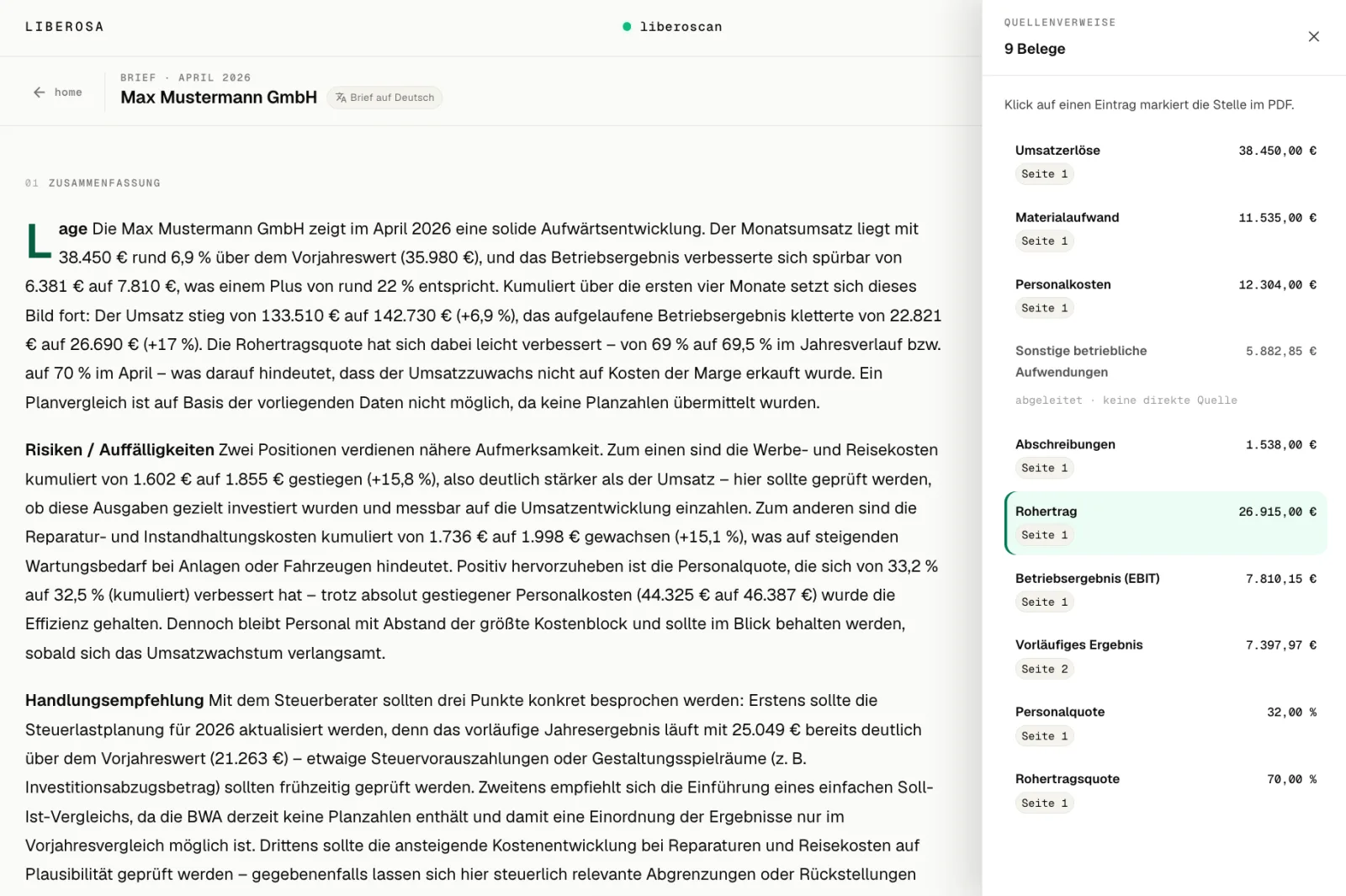
Liberoscan
My own product. If you want to see how I build, it is the shortest way.
A financial report goes in, a finished briefing comes out – an English P&L as readily as a German DATEV management report.
Every figure is sourced: click a number and it highlights where it came from in the original PDF.
Under two minutes from upload to finished briefing.
Runs on EU infrastructure, same as anything I build for a client.
What I do
Four ways this usually starts. Most projects are a mix of two.
Build.
From the first line of code to a system in production. Applications, internal tools, integrations, websites.
Take over.
Keep developing systems you already have, including the ones where the last developer is gone and the documentation never existed.
Connect.
I do not replace what works for you. I build what sits between your systems, so a number gets entered exactly once.
Stabilize.
Tests, automated deployment, monitoring, backups that have actually been restored. For everything that only runs today because nobody has touched it.
Four things you can hold me to
Not values. Commitments you would notice if I broke them.
You talk to the person building it.
No sales rep making promises and no engineering team interpreting them differently afterwards. What we agree in a conversation is what gets built.
It keeps running without me.
Automated tests, reproducible deployments, monitoring, verified backups. If a dependency breaks, the rest keeps working. Rolling back takes minutes.
You get everything.
Code, documentation, credentials, infrastructure. If you ever want someone else, they can pick it up. That is exactly why you can trust me with it.
I will tell you when you do not need me.
If the software already exists, I will give you the name instead of rebuilding it expensively. Custom development pays off where the standard does not fit. Not everywhere.
How it starts
What a project costs depends on what it is. Describe it to me and you get a number.
A conversation
You describe what is not working. I tell you whether I am the right person for it, and if I am not, what or who would solve it instead.
Fixed price
You get a fixed price, based on the scope of the project. No day rates that turn into a surprise at the end.
Stays in the EU
Hosted in Europe, with a data processing agreement. Or on your own hardware, if that is what you want.
Who you would be working with
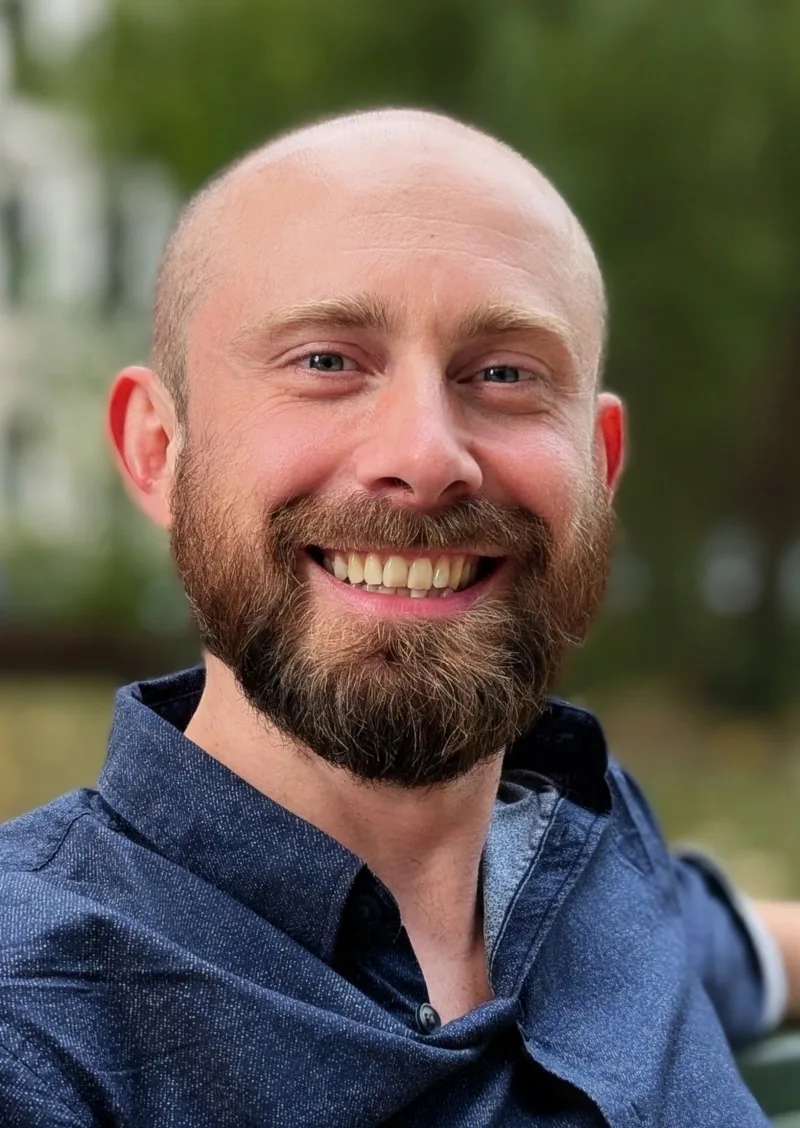
I have been a software developer for 13 years. I started in 2013 on a citation engine used by students worldwide – first at Imagine Easy Solutions, then at Chegg after the acquisition. After that, more than seven years at orgavision in Berlin, rebuilding the frontend of a quality management platform used by over 200,000 people across more than 800 organizations. I started there as the only frontend developer.
I founded Liberosa UG in early 2026, for a simple reason: I wanted the projects that would take a software agency three people, and that therefore do not add up for a software agency. Working across the entire stack is not a line on a CV here. It is what I do every day, and it is the reason this works at all.
TypeScript, React, Next.js · Node.js, PHP, Python · PostgreSQL · Docker, CI/CD, Linux servers · Hardware and third-party system integration · LLM integration where it serves a purpose
The choice follows the problem, not the trend. If a spreadsheet is enough, I will say so.
Tell me what you are working on.
What kind of business, what is not working right now, what should be different. Three sentences are enough. I usually reply within one business day, and if I am not the right person for it I will say so in that reply.